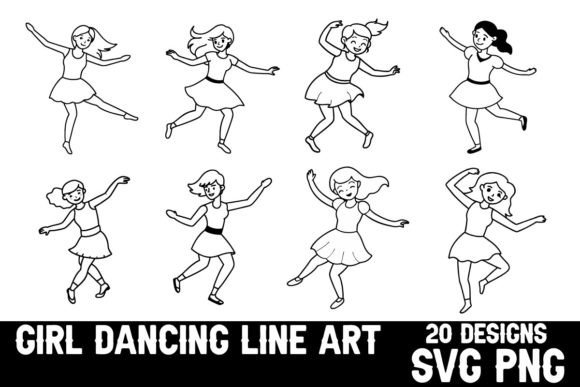
Girl Dancing Line Art Bundle: A Designer’s Review
As a designer who spends half the day tweaking stitch paths and the other half worrying about whether a client will actually wear what they ordered, I don’t just look at an embroidery file; I look at its potential. When I first pulled up the Girl Dancing Line Art Bundle, my initial reaction wasn’t about the technical specs—it was about the mood. In a market saturated with complex floral arrangements and rigid geometric patterns, this design offers something refreshingly simple: movement captured in a single, continuous flow.
This isn’t just another clipart vector slapped onto a hoop. It is a machine embroidery design that understands the language of line work. For those of us running small shops or creating personalized gifts for friends, the difference between a "nice" design and a "sellable" design often comes down to clarity and character. This bundle delivers on both fronts, provided you understand how to translate its digital elegance into thread.
First Impressions: Mood and Visual Personality
The core strength of the Girl Dancing Line Art Bundle lies in its minimalism. The figure is rendered in clean, unbroken lines that suggest grace without demanding excessive detail. From a design perspective, this is smart. It creates a modern, boutique aesthetic that appeals to a wide demographic—from millennials looking for trendy custom apparel to parents seeking delicate baby embroidery pieces.
When I visualize this design stitched out, it doesn’t scream for attention; it whispers. It works beautifully as a standalone focal point on a white cotton tee or as a subtle accent on a dark denim jacket. The visual personality is playful yet sophisticated. It feels like a sketch brought to life, which gives it a hand-drawn warmth that many machine-made designs lack. This is crucial for handmade product branding, where authenticity matters more than perfection.
Real-World Application: Where Does It Fit?
Let’s talk about practical use. I recently imagined using this design for a series of custom tote bags for a local artisan market. The flowing lines of the dancer would contrast nicely against the structured canvas of a tote, adding a touch of whimsy without overwhelming the bag’s utility. Because the design relies on open space and thin lines, it avoids the heavy, stiff feel that dense fill stitches can sometimes create.
However, the versatility of this embroidery file extends far beyond bags. Here is how I see it performing in various real-life scenarios:
- Apparel Decor: On a sweatshirt, the line art provides a sleek, graphic look that pairs well with streetwear aesthetics. It works particularly well when placed over the heart or centered on the back, allowing the negative space of the fabric to become part of the composition.
- Baby Items: For onesies or burp cloths, the gentle curves are perfect. It’s soft, non-aggressive, and visually calming. As a personalized gift, it feels thoughtful and tender, especially when stitched in pastel threads.
- Kitchen and Home: I see this doing excellent work on tea towels or aprons. The dancing figure adds a bit of joy to mundane tasks. On a kitchen towel, the high contrast of black thread on white linen (or vice versa) makes the lines pop, ensuring the design remains legible even after washing.
- Patches and Caps: If converted into an embroidered patch, the clean edges make trimming and backing application straightforward. On a cap, the curved nature of the dancer complements the shape of the front panel, creating a cohesive silhouette.
Technical Considerations and Stitch Behavior
While the concept is strong, execution is everything. As an experienced reviewer, I must highlight where caution is needed. Line art in embroidery is deceptive; what looks like a simple stroke on screen can behave unpredictably depending on your stitch density and fabric choice.
If you are planning to use this for commercial embroidery or mass production, you need to pay close attention to the following:
- Fabric Texture: Avoid highly textured fabrics like heavy bouclé wool or thick fleece for this specific design. The fine lines may get lost in the weave. Stick to smooth cottons, poly-cotton blends, or stable knits where the needle can penetrate cleanly.
- Thread Contrast: The success of line art hinges on visibility. Using a thread color that is too close to the fabric background will result in a muddy, indistinct image. High contrast is key—think black on white, white on navy, or metallic gold on cream.
- Hoop Size Stability: Ensure your hoop size is appropriate for the scale of the design. If the dancer is stretched too large, the lines may break or appear pixelated. If shrunk too small, the details vanish. Test on scrap fabric first to find the sweet spot.
- Stabilizer Choice: Even with light designs, proper support is vital. Use a cut-away stabilizer for stretchy fabrics like t-shirt material to prevent distortion during stitching. For woven items, a tear-away might suffice, but always test for pull-in.
Designing for Clarity and Value
One aspect that often gets overlooked is how the design affects perceived value. A poorly executed line art piece can look cheap and frayed. However, when stitched with precision, the Girl Dancing Line Art Bundle elevates the finished product. It signals to the buyer that care was taken in the creation process. This is essential for Etsy sellers and small shop owners who compete on quality rather than price alone.
Consider the end-user experience. A customer buying a holiday gift or a wedding gift wants something that looks professional. The clean lines of this design convey professionalism. It doesn’t look like a rushed job; it looks intentional. This boosts customer trust and encourages repeat business.
Strategic Placement and Mockups
Before committing to a full run, I strongly advise creating printable mockups. View the design in black and white to check for balance. Does the eye travel smoothly along the dancer’s form? Are there any awkward gaps where the line breaks unexpectedly? These questions help refine your presentation before the needle even touches the fabric.
For digital product sellers, this bundle offers great flexibility. You can offer it as a digital embroidery file for instant download, catering to the growing community of home embroiderers. Alternatively, you can use it to create physical design assets like stationery sets, branded merchandise, or boutique clothing lines. The key is consistency. If you build a brand around minimalist, artistic embroidery, this design fits seamlessly into that narrative.
Final Verdict
The Girl Dancing Line Art Bundle is not just a decorative element; it is a versatile tool for creative entrepreneurs. It bridges the gap between technical embroidery and artistic expression. While it requires careful attention to fabric choice and thread contrast, the payoff is a stunning, modern design that resonates with buyers.
Whether you are making a tote bag design for a summer fair, adding a personal touch to a sweatshirt embroidery project, or expanding your catalog of graphics for crafters, this bundle holds its own. It is a testament to the power of simplicity in design. Just remember: test, test, and test again. Your customers will thank you for the polish, and your reputation will benefit from the reliability.
In the world of crafts and handmade goods, standing out means finding the right balance between trend and timelessness. This design captures that balance perfectly. It is elegant enough for a high-end boutique but accessible enough for a hobbyist’s first major project. For anyone looking to add a touch of graceful motion to their embroidery repertoire, this is a worthy addition.